17.11.25
Operationalising the EWIPA Political Declaration: A New Toolkit for Strengthening Civilian Protection
By laura.boillot
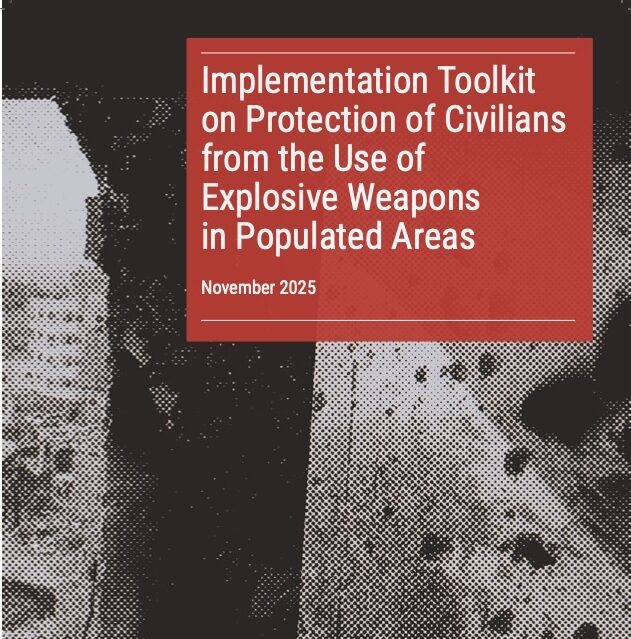
Civilian suffering in modern conflicts remains unacceptably high, driven in large part by the widespread use of explosive weapons in towns and cities. These weapons, particularly those with wide-area effects, cause predictable patterns of harm: death and injury, displacement, psychological trauma, and the destruction of homes, hospitals, water networks, power systems, and other essential infrastructure.
To address these humanitarian consequences, a new Implementation Toolkit has been developed by Article 36 and Airwars to help states and armed forces operationalise the commitments of the 2022 Political Declaration on Strengthening the Protection of Civilians from the Humanitarian Consequences of Explosive Weapons in Populated Areas. The toolkit is a practical implementation resource designed to translate the Declaration’s commitments into concrete measures, policies, and practices that reduce civilian harm and strengthen protection in populated areas.
Practical guidance for urban conflict
Contemporary conflicts frequently take place in the midst of civilian life, where the effects of explosive weapons are magnified by proximity and density. These weapons project blast, heat, and fragments that can cause severe injury and damage to the built environment. Even parties that seek to adhere closely to international humanitarian law have caused significant civilian harm when using explosive weapons with wide-area effects in populated areas.
The toolkit provides an action-oriented and flexible framework that can be adapted to different national systems, capacities, and priorities. It draws on reflections and recommendations from a series of military workshops and conversations with current and former members of armed forces from different backgrounds. It breaks the Declaration’s commitments into clear areas of work supported by objectives, indicators, suggested actions, and examples of existing practice. This structured approach aims to help governments and armed forces integrate the Declaration into policy, doctrine, training, planning, and operational behaviour.
Strengthening standards and practice
Many existing tools and procedures were not designed to address these risks, and the toolkit highlights the need to update doctrine, targeting frameworks, and training accordingly. Adapting or developing new operational standards that reflect the risk of civilian harm is essential to translate political commitments into concrete military practice. By incorporating these approaches into operations—and, where feasible, avoiding the use of heavy explosive weapons in populated areas—states can significantly reduce civilian harm while strengthening operational effectiveness, upholding humanitarian principles, and reinforcing international standards for responsible military conduct.
Operational guidance should:
- Define restrictions on the use of specific weapons and munitions in populated areas based on technical understandings, effects and characteristics of weapons and contexts of use.
- Strengthen identification of civilian infrastructure and protected sites prior to strikes.
- Track and analyse civilian harm systematically, using data to adapt policy and practice.
- Incorporate training and directives to ensure operational personnel apply these measures effectively.
These measures help translate political commitments into operational practice and strengthen coherence from strategic to tactical levels. They also support the broader aim of building a culture of civilian protection within armed forces, where the mitigation of civilian harm is understood as both a humanitarian obligation and an operational imperative.
A path towards implementation
The toolkit supports baseline reviews of national policies and practices, time-bound implementation, and ongoing assessment of progress in reducing civilian harm. This approach helps national institutions identify gaps, build on existing good practices, and pursue continuous improvement.
The toolkit underlines the importance of transparency, information-sharing, and cooperation. It encourages states to support the work of the United Nations, the ICRC, and relevant civil society organisations that collect data on the humanitarian impacts of explosive weapons. It also notes the value of international exchanges, monitoring efforts, and voluntary reporting in fostering shared learning and strengthening the global norm against the use of explosive weapons in populated areas. It is designed to be a living resource.