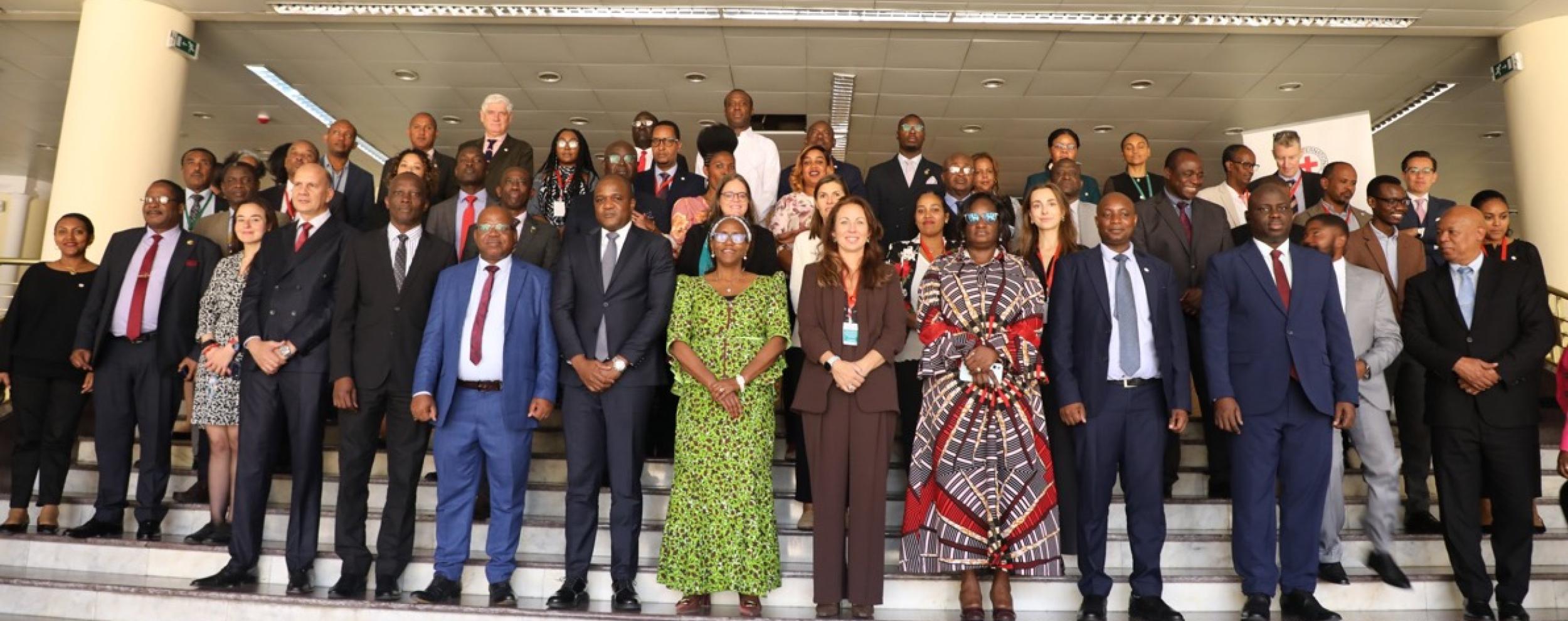
African Union consultation advances a Common Plan of Action on explosive weapons in populated areas
On 1 October 2026, a consultation at the African Union in Addis Ababa started discussions to develop a ‘Common Plan of Action’ on strengthening the protection of civilians from the use of explosive weapons in populated areas. Convened by the AU Commission, the consultation formed the first step in an AU- and member-state-led process, with technical support from Article 36 and the International Committee of the Red Cross (ICRC), and participation from the International Network on Explosive Weapons (INEW) and INEW member organisations.
This follows the Communiqué adopted by the AU Peace and Security Council PSC/PR/COMM.1271 (2025), which, among its EWIPA-related provisions:
encourages all Member States “to urgently review and adapt military policies and practices and to adopt policy measures limiting the use of explosive weapons with a wide impact area in populated areas unless sufficient mitigation measures are taken to limit their broad area effects and the risk of civilian harm” (paragraph 15);
requests the AU Commission “to continue sensitizing Member States in promoting a better understanding of the humanitarian impacts of explosive weapons … as well as the importance of … [the] EWIPA Political Declaration, and the policy and practical changes it seeks to generate”, and encourages Member States that have not yet done so to endorse the Declaration (paragraph 16); and
encourages Member States to “draft a Common Plan of Action outlining steps in support of the Declaration” (paragraph 17).
The proposed Common Plan of Action would support implementation of the Political Declaration on Strengthening the Protection of Civilians from the Humanitarian Consequences Arising from the Use of Explosive Weapons in Populated Areas, adopted in November 2022 and now endorsed by 92 states worldwide, including 15 states in Africa.
The consultation: priorities for a Common Plan of Action
The consultation brought together defence attachés and representatives of AU member states based in Addis Ababa. INEW and some member organisations participated, contributing civil society perspectives and experience.
Opening the meeting, the AU Commission described it as “the beginning of a collective reflection” - an opportunity to listen to member states, identify what is already working, and consider where collective action through the AU can add value. The meeting was an initial consultation on priorities and possible measures for the plan.
Expert briefings addressed the humanitarian impact of explosive weapons in populated areas, existing AU priorities and frameworks, the changes in military policy and practice promoted by the Political Declaration, and African experience on which implementation can build.
Sierra Leone, drawing on its experience of conflict, stressed that “the effects of explosive weapons do not end when the fighting stops. The humanitarian, social and developmental consequences may remain long after peace has been restored.” It identified a central challenge as “the gap between international humanitarian law and political commitment on one hand, and operational military practice on the other”.
Its representative emphasised that “commanders and planners require practical guidance that translates the principles of distinction, proportionality and precautions in attack into decision-making concerning target selection, choice of weapons, timing of operations, and assessment of foreseeable direct and indirect effects on civilians.” Sierra Leone proposed common operational guidance, strengthened training and improved civilian harm recording, and offered to share its experience with other states. Protecting civilians requires action “before, during and after the use of force”.
Working groups considered four proposed objectives for the Common Plan of Action:
Institutionalising responsibility and coordination.
Reviewing and adapting military policies and practices.
Expanding African endorsement of, and leadership on, the Political Declaration.
Supporting people and communities affected by explosive weapons.
Discussions indicated broad support for developing the plan and for these objectives. Participants highlighted the role of Regional Economic Communities, Regional Mechanisms and the African Standby Force in sharing experience and carrying continental commitments into national practice. Practical proposals included support for regional training centres, joint exercises and training of trainers, including on weapons effects and risks to civilians and critical infrastructure.
Participants also emphasised assistance to affected communities, including rehabilitation and psychosocial support, risk education, and coordination across defence, foreign affairs and other ministries. These priorities will inform further consultations on how the plan can connect African policy commitments with practical measures to strengthen civilian protection.
An urgent task with existing African foundations
Recent and ongoing armed conflicts around the world - including in the Democratic Republic of Congo, Ethiopia, and Sudan - have shown that the use of explosive weapons with a wide impact area in populated areas is a major cause of civilian harm.
Strengthening protection from explosive weapons in populated areas is an immediate priority as around 45 per cent of Africa’s population now lives in urban areas, with the urban population growing and expected to double by 2050.
But as Kenya’s Deputy Permanent Representative to the AU Petronila Were highlighted, “Africa should not only be viewed as a continent affected by these challenges, but also as a contributor to the development of international norms, military practice, and approaches to peace and security”.
There is already African policy support for strengthening protection of civilians from EWIPA - representatives of 19 African states agreed the Maputo Communiqué (2017) on the need to avoid the use of explosive weapons with wide area effects in populated areas. And the AU’s policy commitments and the wider ambition of Silencing the Guns and Agenda 2063 also provide substantial foundations for action, reflecting the recognition that the use of explosive weapons in populated areas contributes to insecurity and undermines development.
Some African states have also begun to operationalise the Declaration, sharing progress in the workshops and international conference discussions. Additionally, African states and AU operations have relevant operational policies and practices from the region that pre-date the Declaration.
Malawi: The Malawi Defence Force has adapted its Fighting in Built-Up Areas (FIBUA) doctrine towards avoiding combat in towns and cities. It has integrated the Declaration’s commitments into training, operational guidance and planning, including assessment of weapons effects in populated environments and procurement approaches aimed at avoiding weapons with wide-area effects, alongside policies prohibiting certain types of explosive weapons.
Nigeria: The Nigerian Air Force has adopted a Civilian Harm Mitigation and Response Action Plan (CHMR-AP) and established a Civilian Harm Mitigation and Response Board to oversee its implementation across NAF operations, including joint theatres. A dedicated Civilian Harm Assessment and Investigation Cell compiles data on civilian harm, conducts assessments, analyses patterns and tracks progress, drawing on military assessments as well as information from civil society, NGOs and other sources. The mechanism is intended to ensure that lessons from civilian harm inform operational practice and strengthen accountability.
Madagascar: Following endorsement of the Political Declaration, Madagascar developed a national implementation strategy centred on legislative review, civil-military coordination and the integration of EWIPA into military training. Practical measures have also included closing military storage and training sites considered too close to expanding populated areas.
Morocco: As a major contributor to UN peacekeeping, Morocco has built the Declaration into the IHL courses at its military academies, and into pre-deployment training for Moroccan Blue Helmets on protecting civilians from explosive weapons. Before operations, units assess population density and how close hospitals, schools, water and power facilities are to military targets. Battle damage assessment is used, and specialist teams investigate alleged harm to civilians afterwards. Morocco has also built civil–military coordination with humanitarian organisations, and last year hosted the Rabat regional workshop to exchange policies and practice in the region.
These efforts sit alongside operational experience such as:
African Union operations in Somalia: AMISOM developed an Indirect Fire Policy that placed restrictions on the use of mortars and artillery in populated areas, including senior command approval, assessment of civilian risk, pre-strike checks and post-strike assessment. This has been complemented by AU civilian harm tracking mechanisms, continued under AUSSOM, through which information on civilian harm is analysed and reported to senior leadership and used to inform adaptations to tactics, doctrine and training.
G5 Sahel Joint Force: The Joint Force developed a Human Rights and International Humanitarian Law Compliance Framework, supported by OHCHR, which incorporated civilian protection into military doctrine, planning, after-action review and accountability mechanisms. It also established a Casualty and Incident Tracking and Analysis Cell to identify and analyse civilian harm, support remedial action and inform adaptations to doctrine and operational conduct. Although the Joint Force is no longer operational, this experience remains relevant.
Operationalising the Declaration and consolidating experience
A Common Plan of Action could provide practical guidance to operationalise the Declaration, including one of its central commitments: avoiding or restricting the use of explosive weapons with wide-area effects in populated areas.
It could also consolidate regional experience and help build an African community of practice, making it easier for states and armed forces to learn from approaches developed elsewhere on the continent, and to bring those experiences into the wider international EWIPA process.
Wider endorsement and further consultation
Fifteen African states have endorsed the Political Declaration: Cabo Verde, Central African Republic, Comoros, Côte d’Ivoire, Kenya, Lesotho, Liberia, Madagascar, Malawi, Morocco, Nigeria, Senegal, Sierra Leone, Somalia and Togo.
Greater endorsement by AU member states remains important. Implementation and wider endorsement can reinforce one another: practical experience can inform dialogue with states considering endorsement, while broader participation can strengthen cooperation on implementation.
Developing the plan should engage foreign ministries, armed forces, civil society, Regional Economic Communities (RECs) and Regional Mechanisms (RMs). These actors have important roles in shaping its priorities and supporting its implementation.
Article 36 and the ICRC look forward to providing continued technical support to further consultations with states on developing the Common Plan of Action, under the leadership of the African Union and African member states.
Article 36 resources
Practical guidance and regional experience to support implementation of the Political Declaration:
Article 36 and Airwars, EWIPA Implementation Toolkit — practical guidance for states and armed forces on translating the Declaration’s commitments into military policy and practice.
Article 36 and Airwars, Avoiding Civilian Harm by Restricting or Refraining from Use of Explosive Weapons in Populated Areas — policy paper on operationalising restrictions to prevent civilian harm.
Article 36 and Airwars, Tracking Civilian Harm from the Use of Explosive Weapons in Populated Areas — policy paper on using civilian harm tracking and analysis to inform operational decisions and changes in practice.
Article 36, Regional Roundtable Report: Johannesburg, South Africa, 27–28 February 2025 — regional discussions on endorsement, implementation and African policy and practice.
Article 36, Africa Regional Workshop Report: Accra, Ghana, 14–15 April 2026 — African experiences and recommendations on civilian protection, military practice and regional cooperation.
Article 36, Committing to Civilian Casualty Tracking in the Future Political Declaration on the Use of Explosive Weapons in Populated Areas (April 2022) — explains how tracking and analysing civilian casualties can inform changes to tactics and operational policies to strengthen civilian protection.